

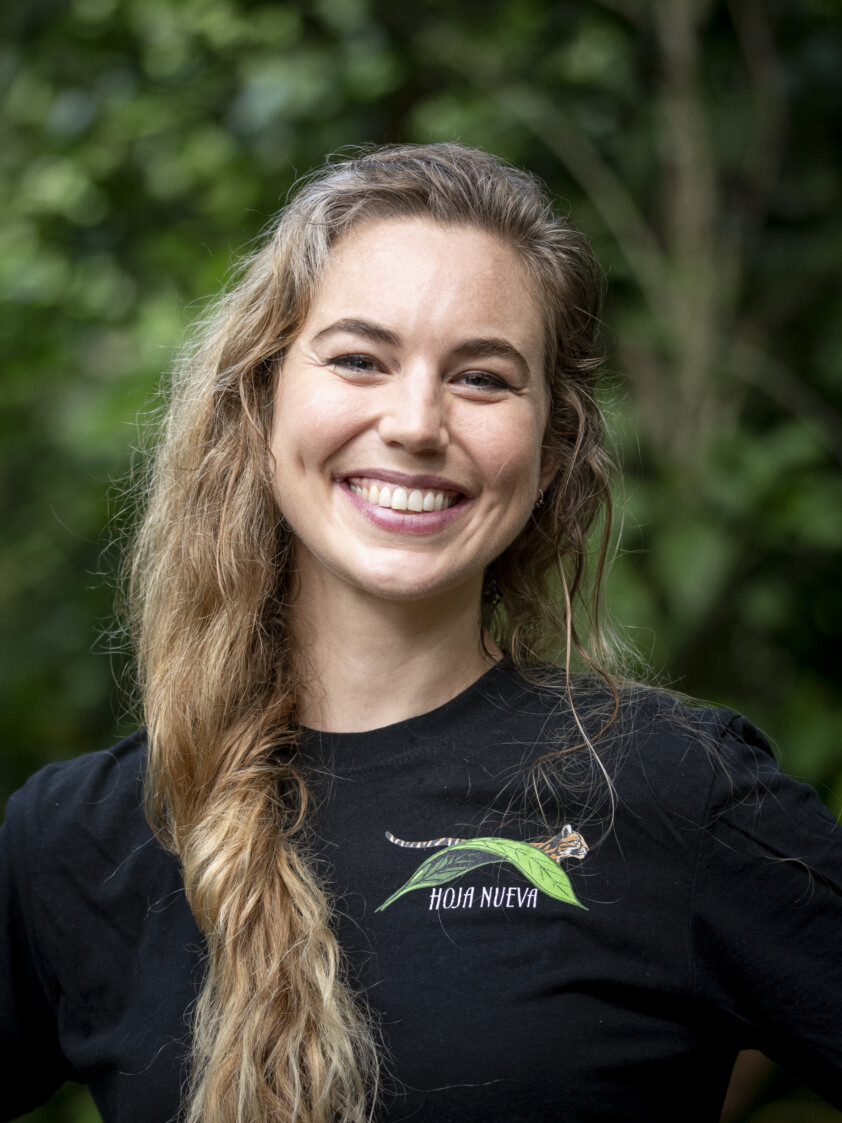
Samantha Zwicker
Founder & Co-Director – Quantitative Ecologist
Brief info
Samantha Zwicker is a tropical and quantitative ecologist, wildlife rehabilitation specialist, and founder and co-director of Hoja Nueva. She earned her PhD in Quantitative Ecology from the University of Washington, where her research focused on elusive Amazonian felids, non-invasive wildlife monitoring, and the effects of human disturbance on mammal communities across an unprotected landscape. She also holds a master’s degree in conservation ecology, a bachelor’s degree in environmental studies, and training in nonprofit management.
Samantha first began field research in Madre de Dios in 2014 and founded Hoja Nueva in 2015 after witnessing both the extraordinary biodiversity of the Las Piedras watershed and the growing threats posed by habitat conversion, hunting, and wildlife trafficking. Her work has since grown across four connected areas: wildlife rescue and rewilding, ecological research, habitat protection, and community conservation.
She has particular expertise in felid ecology and rehabilitation. Hoja Nueva’s work has included more than 20 permitted ocelot and margay releases, including pioneering documented reintroductions of animals affected by captivity and the pet trade. Samantha has worked with SERFOR on felid rehabilitation and release frameworks and is now helping develop the behavioral, veterinary, ecological, genetic, and monitoring foundations for Hoja Nueva’s proposed jaguar releases.
Her research uses camera traps, spatial ecology, occupancy modeling, density estimation, activity analyses, and increasingly genetic collaboration to study carnivore populations and interactions across Amazonian landscapes. She continues to mentor undergraduate and graduate researchers and oversees Hoja Nueva’s long-term research program.
Samantha remains directly involved in complex wildlife cases, rehabilitation strategy, data analysis, government and scientific partnerships, fundraising, community programs, and organizational planning. Her conservation philosophy is rooted in the belief that rigorous science, animal welfare, rewilding, intact habitat, and local capacity cannot be separated—and that the strongest conservation programs ultimately become capable of continuing beyond their founders.